

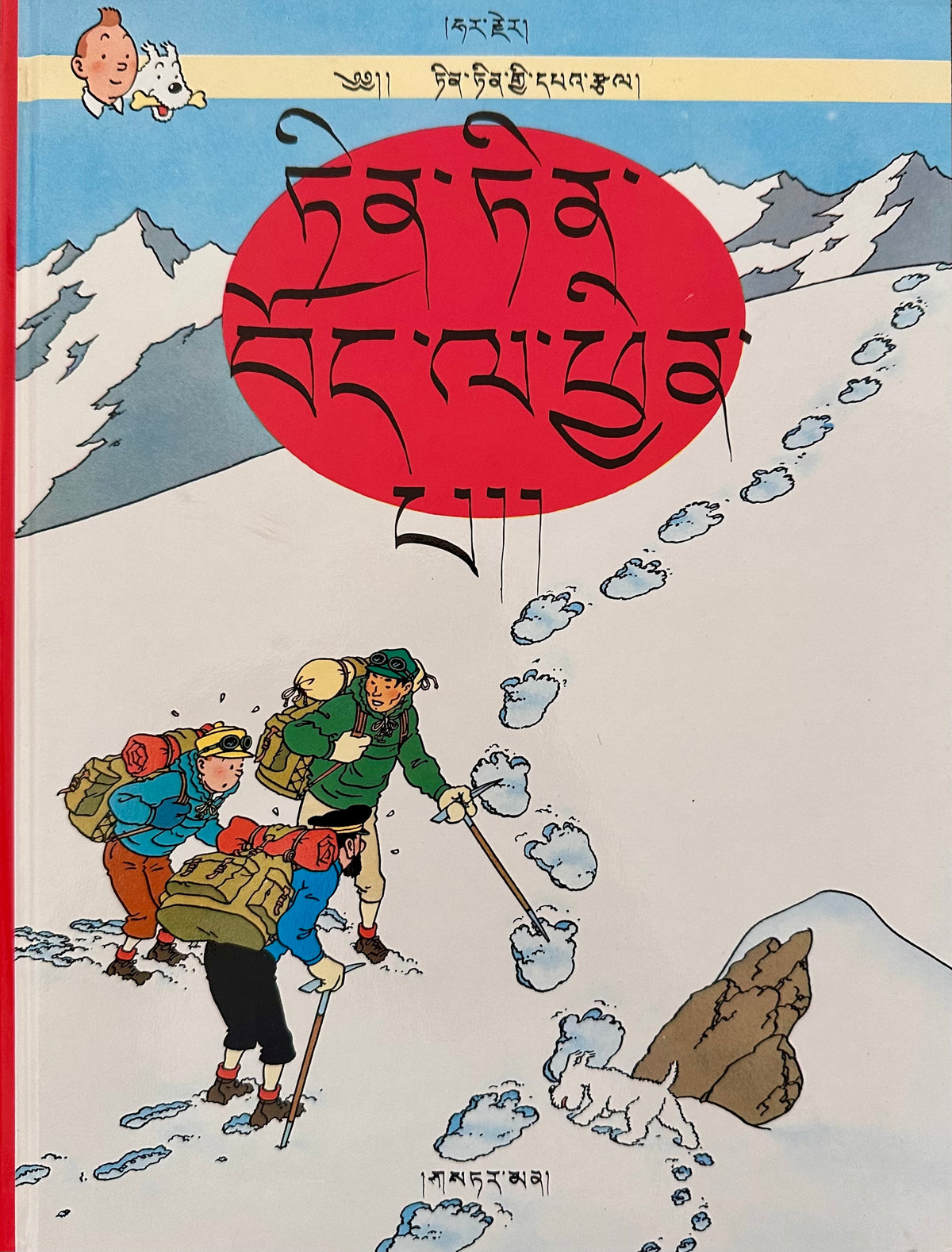

Tintin in Tibet in Tibetan: The Story Behind a Rare Collector’s Item
Some time ago we showed a few pictures on Instagram from a special comic album we had come across by chance: Hergé’s «Tintin in Tibet» – in Tibetan script! We did not want to pass on this rare piece before we had found out more about its background.
Hergé’s most personal work
«Tintin au Tibet» appeared in 1958–1959 as a serial and in 1960 as an album. It is the 20th volume in the series – and for many the most beautiful. Hergé himself called it his favourite.
There is a reason for this that goes beyond adventure. Hergé created the story during a deep personal crisis: his first marriage was breaking up and he suffered from tormenting nightmares in which he was pursued again and again by large, empty white surfaces. A psychoanalyst advised him to put his work on Tintin aside. Hergé chose the opposite – he poured his inner images into a new story. The dreamed white became the endless snowy landscape of the Himalayas.
«Tintin in Tibet» became the only adventure without a villain. It is a story about friendship: Tintin refuses to believe that his friend Chang died in a plane crash in the Himalayas and sets out against all reason – with Snowy, Captain Haddock and the Sherpa Tharkey – to find him.
The friend who really existed
What many do not know: Chang was not an invented character. Behind him stands the Chinese artist and sculptor Zhang Chongren, whom Hergé met as a young man in Brussels in 1934. Both were 27 at the time, both artists, and they quickly became close friends. Zhang brought Hergé closer to Chinese culture, history and drawing technique, which proved formative for his unique, pared-down style.
Then came the war and the two lost contact – for more than four decades. Hergé never forgot his friend and finally set him a monument in his most important album, by sending Tintin out to search for him.
Life eventually wrote a moving conclusion: in 1981 Zhang was tracked down in China and invited to Europe. On 18 March 1981 the two men embraced again at Brussels airport – after 47 years apart, in tears, in front of a crowd of journalists.
The best-selling book about Tibet
«Tintin in Tibet» has been translated into more than thirty languages. It is considered one of the best-selling books about Tibet of all. For countless people in the West, Hergé’s album was their very first encounter with the landscape, the monasteries and the spiritual world of Tibet.
The «Light of Truth Award»
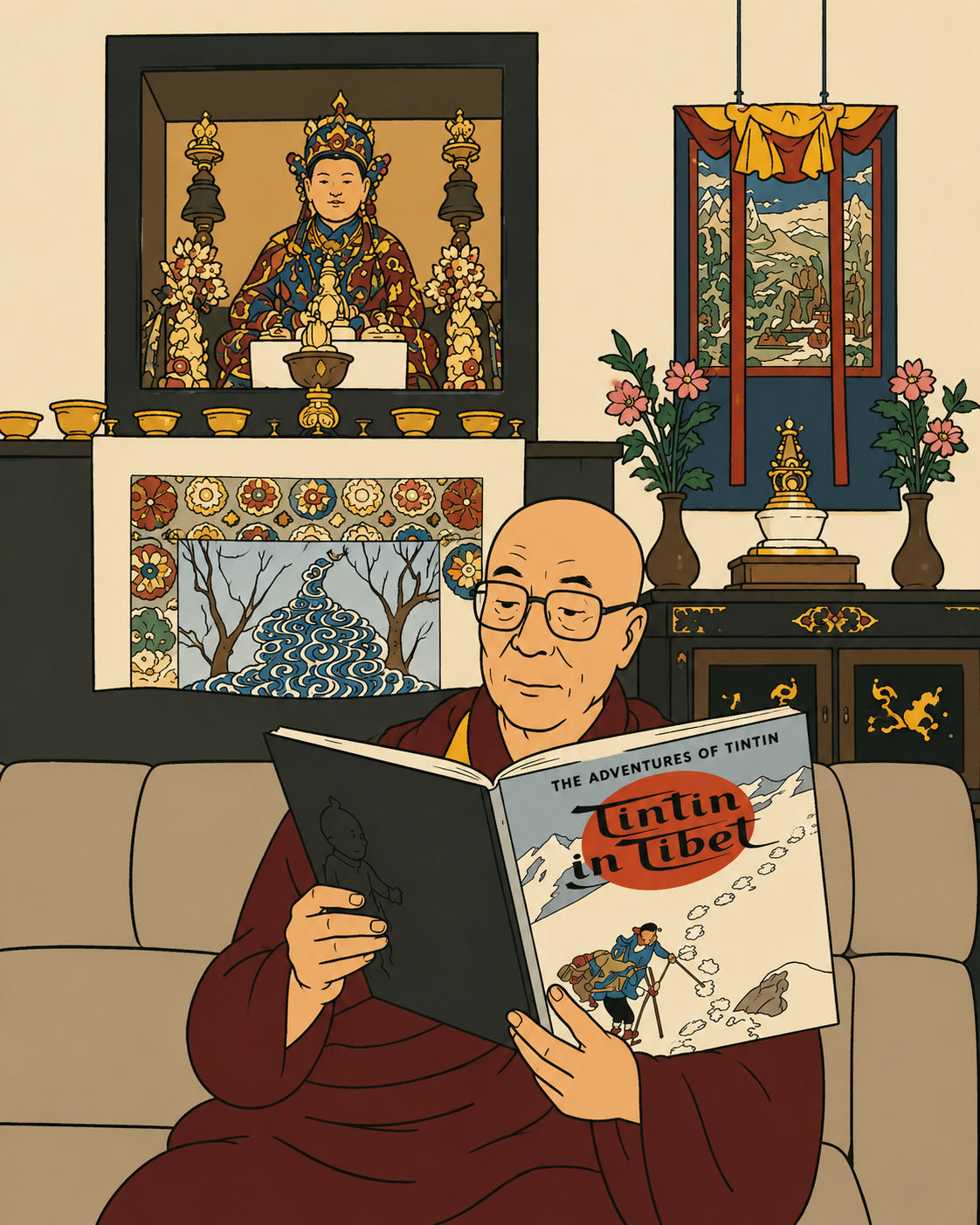
That this story is far more than a children’s book was confirmed at the highest level in 2006: in Brussels, the International Campaign for Tibet awarded the Hergé Foundation the Light of Truth Award – in the presence of and with the appreciation of the Dalai Lama. The award honours those who strengthen awareness of Tibet in the world.
A small footnote to history shows how political this seemingly quiet book can be: when «Tintin in Tibet» was published in China in 2001, the title was simply changed to «Tintin in China’s Tibet». Only after protests by Casterman and the Hergé Foundation did the book get its original title back.
The mystery of the Tibetan edition
While we have found out quite a bit about the history of the album, the Tibetan edition remains a mystery. We have not been able to establish how it came about, the name of the translator or the size of the print run. Even Tintinologist.org, which lists Basque, Bernese German, Vietnamese and Cape Verdean Creole among the many language editions of «Tintin in Tibet», does not include the Tibetan title.
An album whose whole magic lies in the white, in the unsaid, in the mystery of the Himalayas thus becomes a mystery itself in this edition.
We have only one copy – first come, first served.
More affordable and more readily available are the German, French, Italian and English editions.