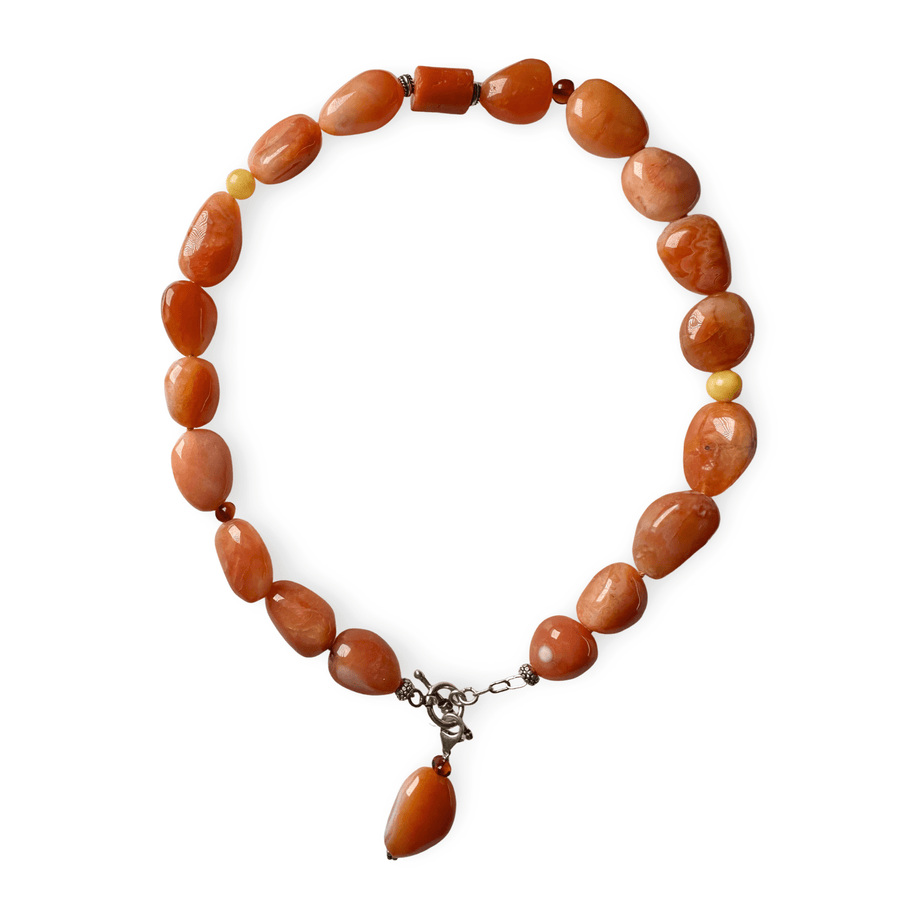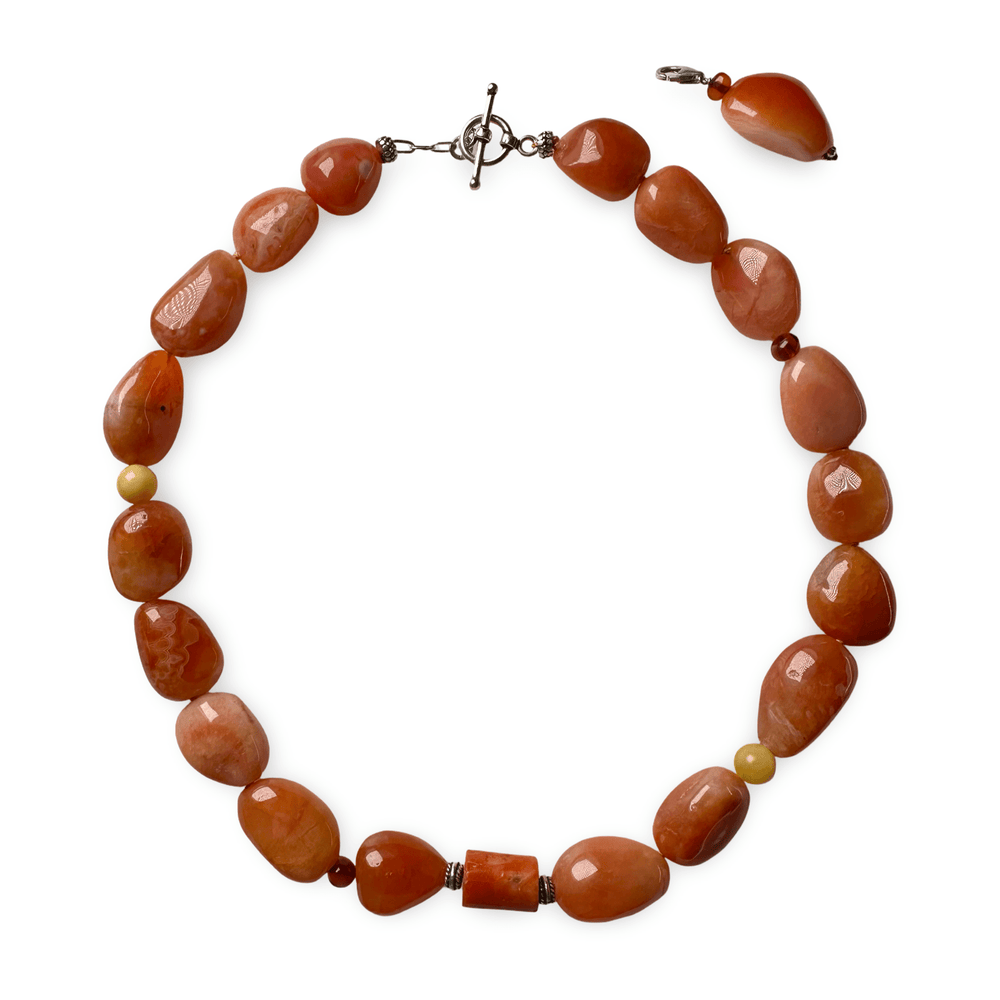

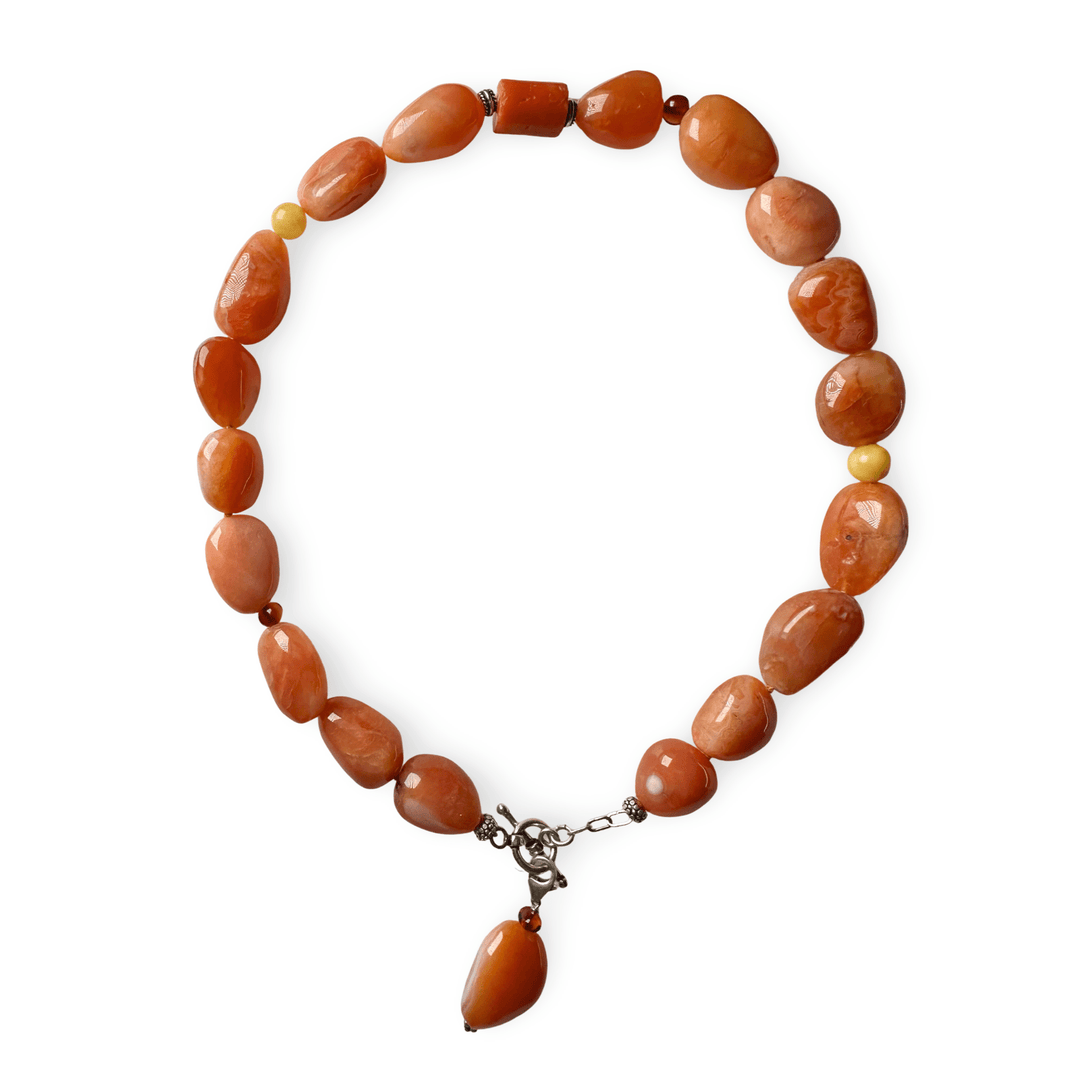
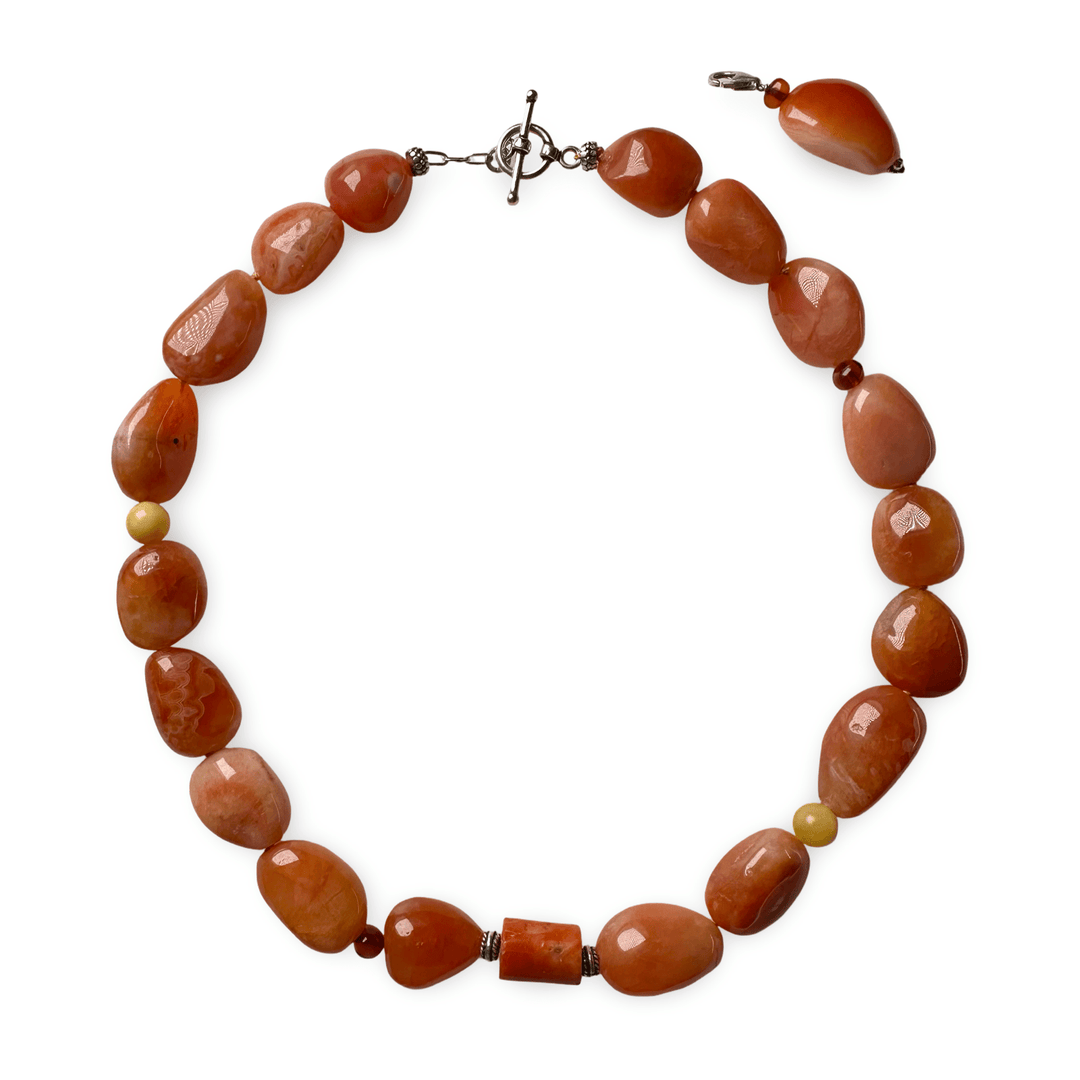
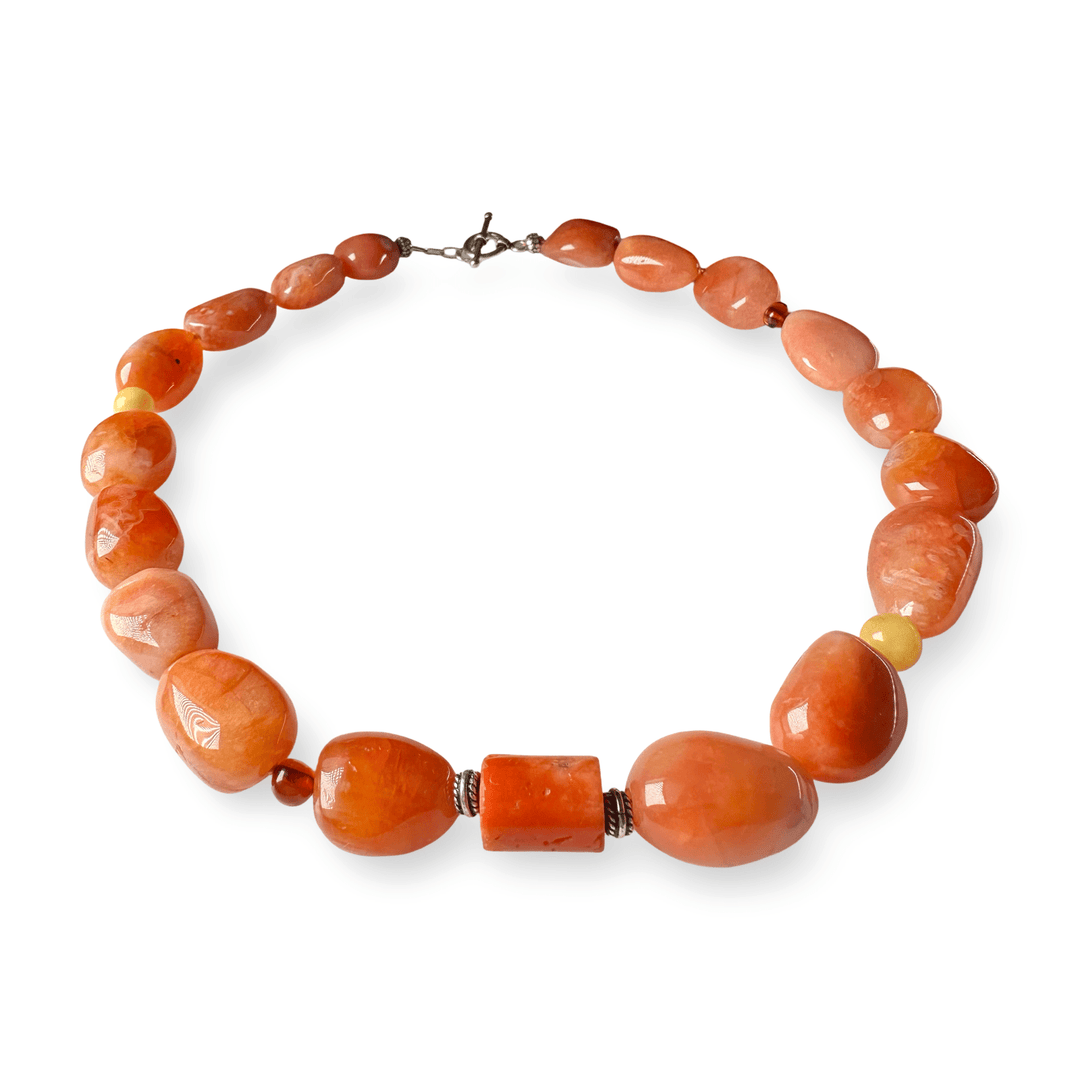


Versatile wearable necklace made from agate, amber, silver and old coral
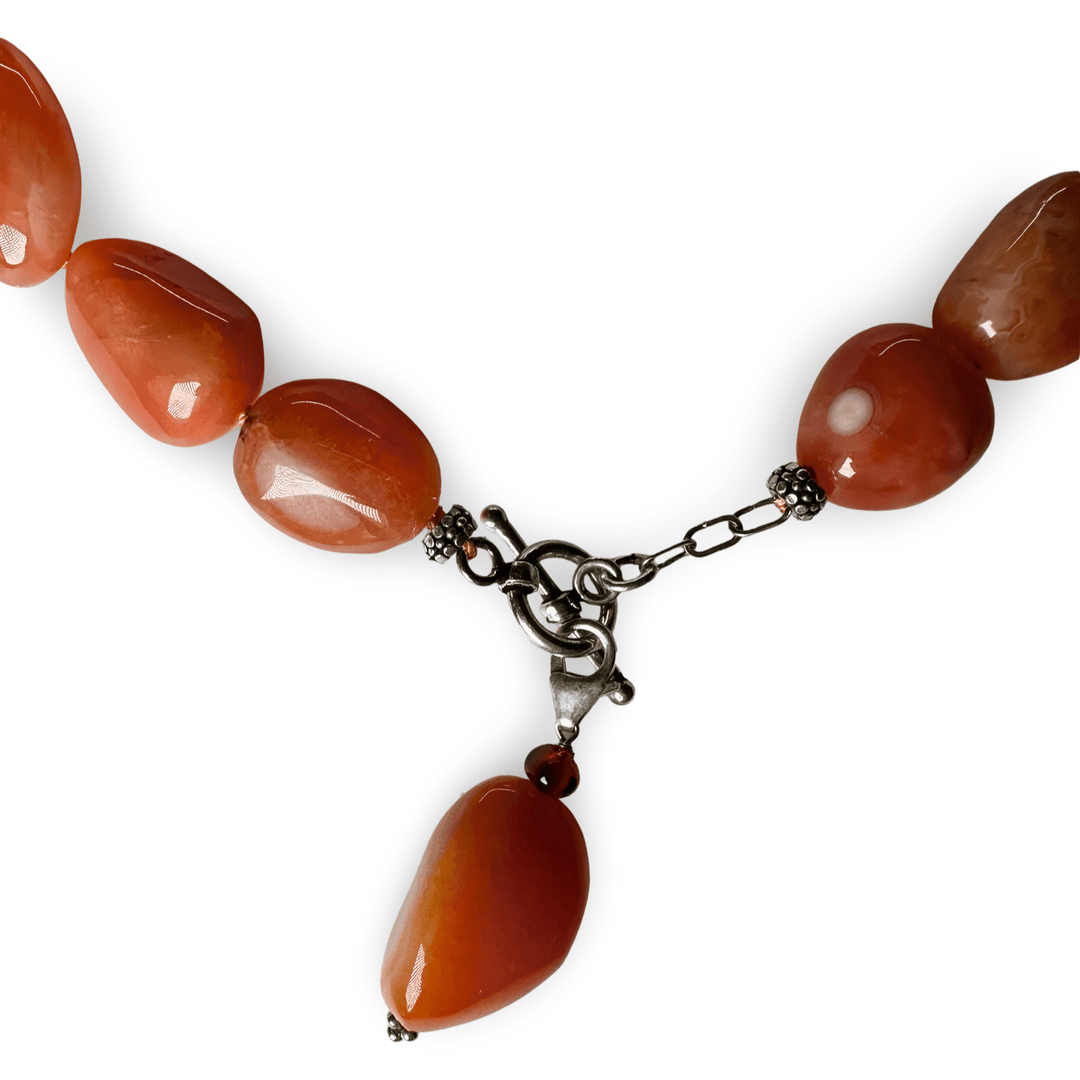
Unusual necklace made from naturally shaped, polished orange-red agate beads with a diameter of approx. 12-15 mm, which are interspersed with amber and silver beads. A large antique coral bead is attached to one side of the necklace. The necklace is fastened with a silver T-clasp. As a special feature, a pendant made of an agate and an amber bead can be attached to the clasp so that the necklace can be worn "upside down". However, the pendant can also be worn separately, e.g. on a silver chain.
The unique piece has a circumference of 46 cm and was handmade in Atelier Tibet in Zurich.
Agate is a banded variety of chalcedony and is formed by the deposition of quartz in cavities in volcanic rocks. The multi-colored, concentric or wavy layers make it a popular decorative stone. Agate has also been used as a protective and healing stone since ancient times and is symbolic of strength and harmony.
Amber is a warm, golden yellow gemstone made from fossil resin that plays an important role in Tibetan jewelry. In traditional pieces of jewelry, it is often used in combination with turquoise, coral and silver. In Tibetan culture, amber symbolizes protection, healing and wisdom. Monks and believers often wear amber as a talisman to ward off negative energies. It is usually crafted by hand, making each piece of jewelry unique and of great cultural value.
Coral has a deep spiritual and cultural significance in traditional Tibetan jewelry. The red precious coral (Corallium rubrum) is particularly prized. In combination with turquoise and silver, coral beads are a characteristic element of Tibetan prayer beads(malas), amulets and ritual jewelry. As Tibet is a landlocked highland, coral was imported from the Mediterranean and the Southeast Asian region via centuries-old trade routes. Nowadays, precious coral is strictly protected, which is why modern Tibetan jewelry is made with old, recycled coral or sustainable alternatives.
This guide helps you find the right size for bracelets, chain bracelets, cuffs, bangles, necklaces and rings. All you need is a tape measure or a strip of paper and a ruler.
Bracelets and chain bracelets

- Wrap a tape measure or string around the wrist where the bracelet will sit.
- It should sit snugly without cutting in.
- Read off the circumference or measure the string with a ruler.
Depending on the desired fit, the bracelet can be 1 to 3 cm longer than the wrist circumference: less for a close fit, more for a loose fit.
Elastic bracelets such as mala bracelets have no clasp. They should fit rather snugly, as they stretch slightly over time. When putting them on, stretch them only as far as necessary.
| Size | Wrist circumference |
|---|---|
| Children | |
| Newborns | 9–12 cm |
| 6 months to 3 years | 12–14 cm |
| 4 to 10 years | 14–15 cm |
| Teenagers | 15–16 cm |
| Women | |
| S | 15–16 cm |
| M | 16–17 cm |
| L | 17–18 cm |
| XL | 18–19 cm |
| Men | |
| S | 17–18 cm |
| M | 18–20 cm |
| L | 20–21 cm |
| XL | 21–22 cm |
Bangles and cuffs

Bangles (closed)
A closed bangle has to slide over the hand. What counts is therefore the widest part of the hand, not the wrist.
- Tuck the thumb into the palm, as when putting on a bangle.
- Measure the circumference across the knuckles at the widest point.
- The inner circumference of the bangle should be slightly larger than this measurement.
Cuffs (open)
An open cuff is slipped onto the wrist from the side. What counts is the wrist circumference, measured as for bracelets. Many cuffs can be gently reshaped. Bend them softly and not repeatedly, otherwise the metal may fatigue.
Necklaces
The length determines where the necklace falls. The easiest way to try it is with a piece of string:
- Place a string around the neck the way the necklace should fall.
- Mark the point where the ends meet.
- Measure the string. This is the right necklace length.
With a pendant, the lowest point moves down by the height of the pendant.
Malas with 108 beads are considerably longer than ordinary necklaces. Their length depends on the bead size. They are worn long or wrapped several times around the wrist.
| Length | Women | Men |
|---|---|---|
| 35–40 cm | close to the neck to base of neck | usually too tight |
| 42–45 cm | on the collarbone | at the base of the neck |
| 50 cm | just below the collarbone | at the collarbone |
| 55–60 cm | on the breastbone | below the collarbone to mid-chest, common with a pendant |
| 70–90 cm | at chest level, long | mid-chest and lower |
Guide values. Because of their larger neck circumference, the same necklace usually sits higher on men than on women. Exactly where it falls depends on neck size and build. The most commonly worn lengths are 42–45 cm for women and 50 cm for men.
Rings
With a ring that fits

- Place a ring that fits well on a ruler.
- Measure the inner diameter, from inner edge to inner edge.
- Look up the diameter in the table.
On the finger

- Wrap a thin strip of paper or thread around the finger where the ring will sit, not too tight.
- Mark the point where the ends meet.
- Measure the length up to the mark in millimetres. It equals the inner circumference and thus the ring size (EU/CH).
Conversion table
Swiss and European ring sizes equal the inner circumference in millimetres. The most common sizes are highlighted. US sizes are rounded guide values.
| EU/CH = inner circumference mm | Diameter inner, mm | US (approx.) | Typical for |
|---|---|---|---|
| 48 | 15.3 | 4.5 | Women very small, children |
| 49 | 15.6 | 5 | |
| 50 | 15.9 | 5.5 | |
| 51 | 16.2 | 5.5 | Women small |
| 52 | 16.6 | 6 | |
| 53 | 16.9 | 6.5 | |
| 54 | 17.2 | 7 | Women, most common sizes |
| 55 | 17.5 | 7 | |
| 56 | 17.8 | 7.5 | |
| 57 | 18.1 | 8 | Women large; men small |
| 58 | 18.5 | 8.5 | |
| 59 | 18.8 | 9 | |
| 60 | 19.1 | 9 | Women very large; men, most common sizes |
| 61 | 19.4 | 9.5 | |
| 62 | 19.7 | 10 | |
| 63 | 20.1 | 10.5 | Men, most common sizes |
| 64 | 20.4 | 11 | Men large |
| 65 | 20.7 | 11 | |
| 66 | 21.0 | 11.5 | |
| 67 | 21.3 | 12 | Men very large |
| 68 | 21.6 | 12.5 | |
| 69 | 22.0 | 12.5 | |
| 70 | 22.3 | 13 |
Tips
Measure in the evening if possible, as fingers swell slightly during the day.
If the measurement falls between two sizes, choose the larger one.
The ring must also fit over the knuckle.
If in doubt, we are happy to measure your size in our shop at Münstergasse 10 in Zurich.