


Traditional Thangka "White Tara"
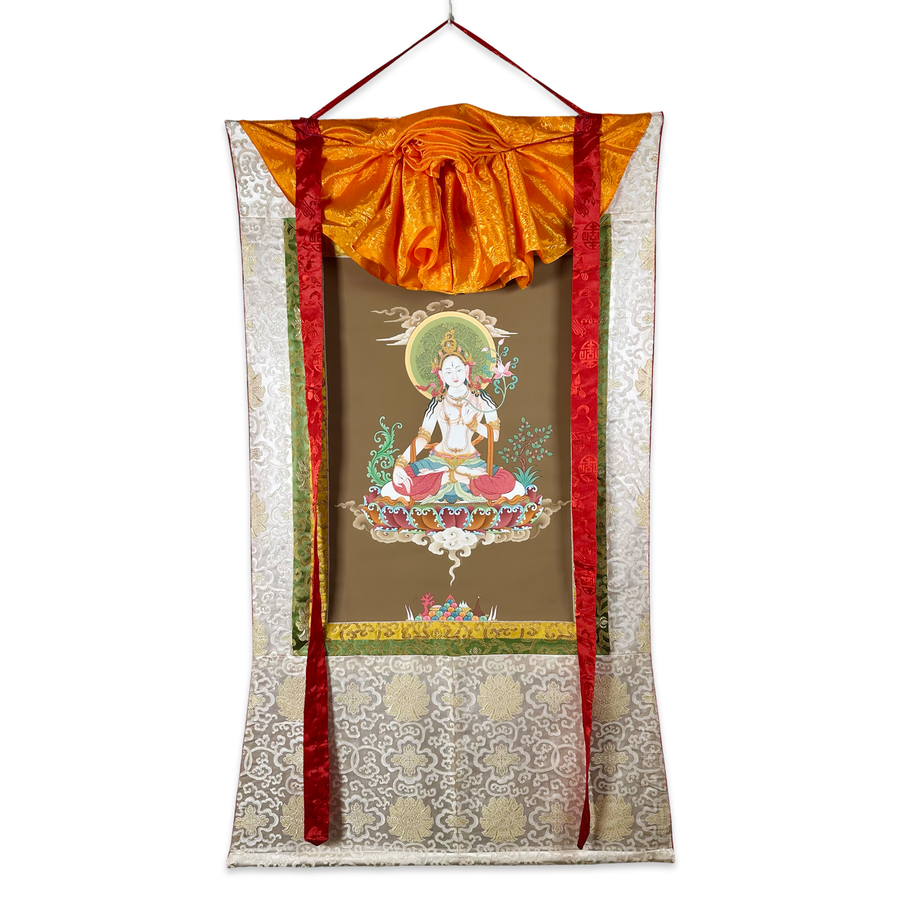
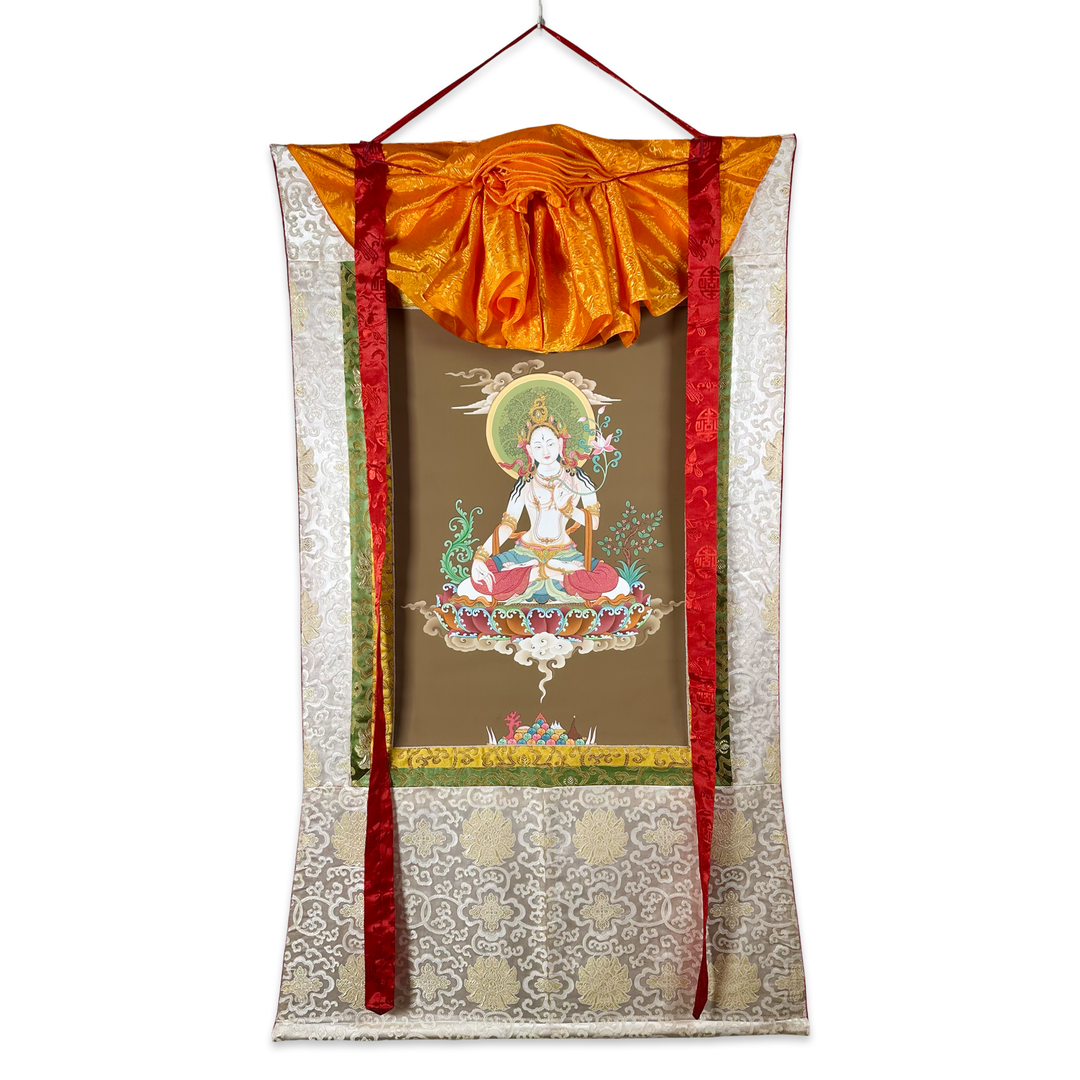
This contemporary hand-painted thangka depicts the White Tara, one of the most important deities in Tibetan Buddhism, worshipped for longevity, healing and compassion.
Details:
- Painting size: 41 x 63 cm
- Brocade frame: 75 (85) x 123 cm
- Brocade colors: Light gold, green, yellow
The painting is of very high quality. As with all of the thangkas available from Atelier Tibet, this is a one-of-a-kind piece that has been painstakingly handcrafted and is only offered once in its details and colors.
These thangkas are hand-painted on canvas by the most experienced artists in Nepal according to the strict iconographic rules of the Tibetan style using traditional colors. They captivate with their intense colors, intricate details and deep spiritual symbolism. The brocade frame is vegan and woven with classic patterns. The thangka is covered with an orange silk veil for protection and decoration.
Description of motif:
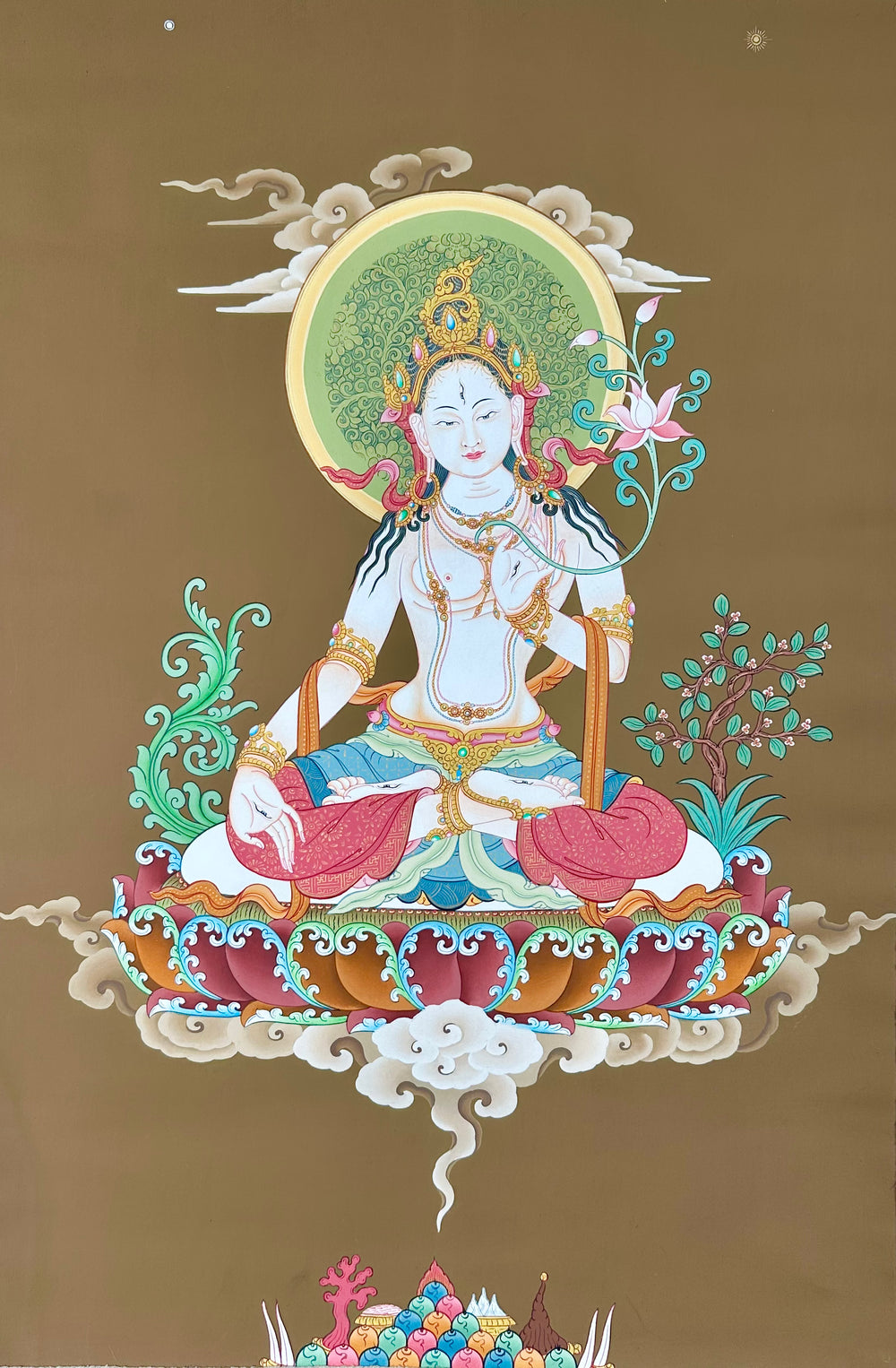
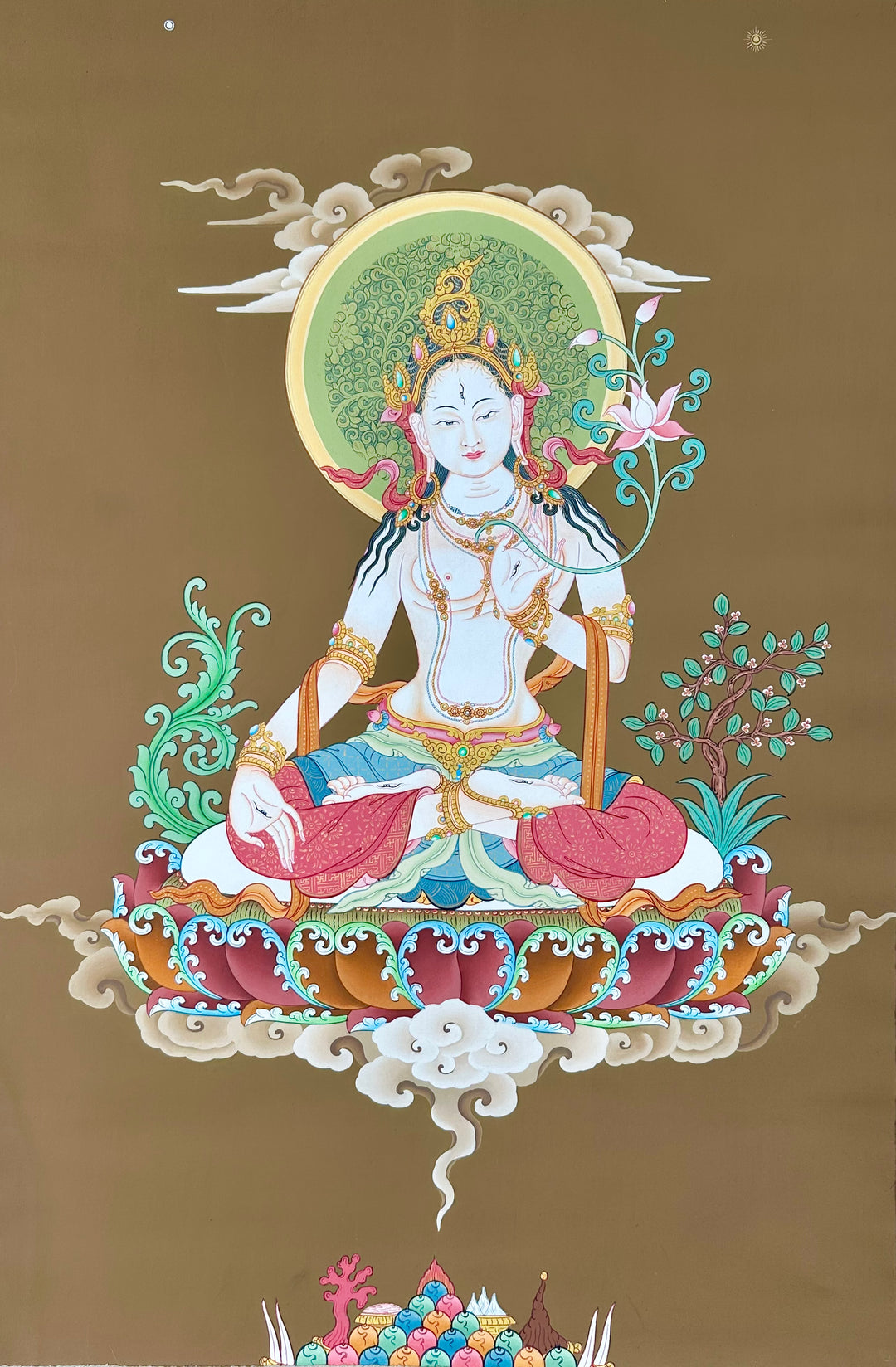
This thangka depicts White Tara (Sanskrit: Sitatara, Tibetan: Dölkar), the embodiment of longevity, healing and compassionate wisdom in Tibetan Buddhism.
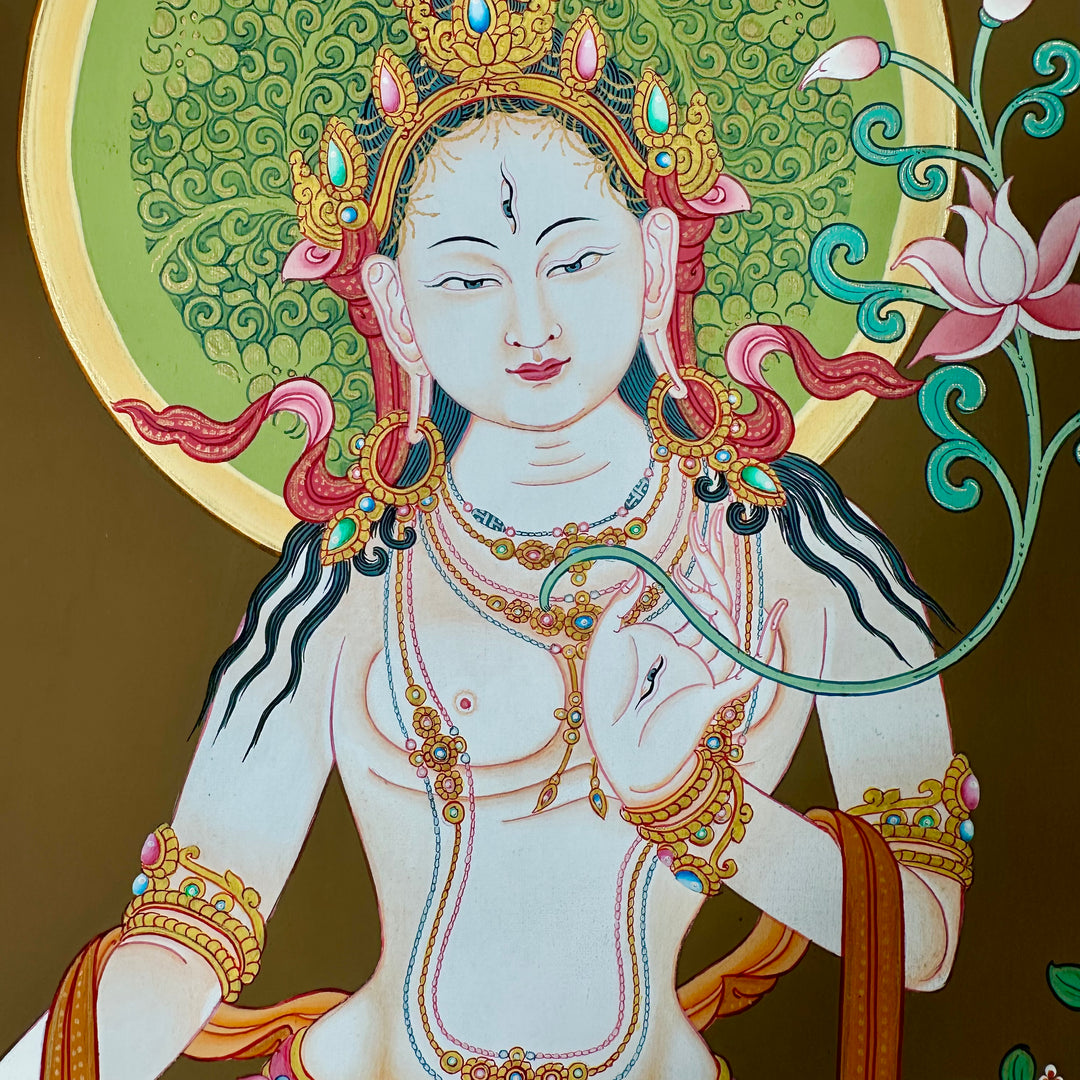
The White Tara sits in a meditative posture on a multi-coloured lotus throne supported by white clouds, symbolizing her transcendent nature. Her body is a radiant white color, expressing purity, healing and infinite compassion. Her face is peaceful and gentle, with a slight smile that radiates compassion and love.
She wears a golden crown, richly adorned with jewels, as well as golden bracelets, necklaces and earrings. Her right hand rests on her knee in the gesture of giving (Varadamudra), while her left hand is raised in the protective posture (Vitarkamudra) in front of her heart, holding a pink lotus (Utpala) that blossoms on her left shoulder. This flower symbolizes purity, wisdom and awakening from samsara.
Typical of White Tara are her seven eyes - one on her forehead, two in the palms of her hands, two on the soles of her feet and her two normal eyes - they enable her to see the suffering of all beings in all realms and to act immediately. In this thangka, her eyes are very finely and delicately drawn, making her loving, peaceful aura even stronger.
Behind her head is a generous green halo with floral ornaments, framed by a golden nimbus and bands of clouds symbolizing her enlightened state. The background is kept simple in a warm brown tone, making her white figure stand out even more brightly. Below the throne is an elaborate sacrificial arrangement with jewels, coral, shells and other symbols of good luck.
This image is often used for meditation on health, healing and longevity, as White Tara is believed to be a source of life-giving energy that helps overcome all obstacles of old age, illness and mental decline.
This guide helps you find the right size for bracelets, chain bracelets, cuffs, bangles, necklaces and rings. All you need is a tape measure or a strip of paper and a ruler.
Bracelets and chain bracelets

- Wrap a tape measure or string around the wrist where the bracelet will sit.
- It should sit snugly without cutting in.
- Read off the circumference or measure the string with a ruler.
Depending on the desired fit, the bracelet can be 1 to 3 cm longer than the wrist circumference: less for a close fit, more for a loose fit.
Elastic bracelets such as mala bracelets have no clasp. They should fit rather snugly, as they stretch slightly over time. When putting them on, stretch them only as far as necessary.
| Size | Wrist circumference |
|---|---|
| Children | |
| Newborns | 9–12 cm |
| 6 months to 3 years | 12–14 cm |
| 4 to 10 years | 14–15 cm |
| Teenagers | 15–16 cm |
| Women | |
| S | 15–16 cm |
| M | 16–17 cm |
| L | 17–18 cm |
| XL | 18–19 cm |
| Men | |
| S | 17–18 cm |
| M | 18–20 cm |
| L | 20–21 cm |
| XL | 21–22 cm |
Bangles and cuffs

Bangles (closed)
A closed bangle has to slide over the hand. What counts is therefore the widest part of the hand, not the wrist.
- Tuck the thumb into the palm, as when putting on a bangle.
- Measure the circumference across the knuckles at the widest point.
- The inner circumference of the bangle should be slightly larger than this measurement.
Cuffs (open)
An open cuff is slipped onto the wrist from the side. What counts is the wrist circumference, measured as for bracelets. Many cuffs can be gently reshaped. Bend them softly and not repeatedly, otherwise the metal may fatigue.
Necklaces
The length determines where the necklace falls. The easiest way to try it is with a piece of string:
- Place a string around the neck the way the necklace should fall.
- Mark the point where the ends meet.
- Measure the string. This is the right necklace length.
With a pendant, the lowest point moves down by the height of the pendant.
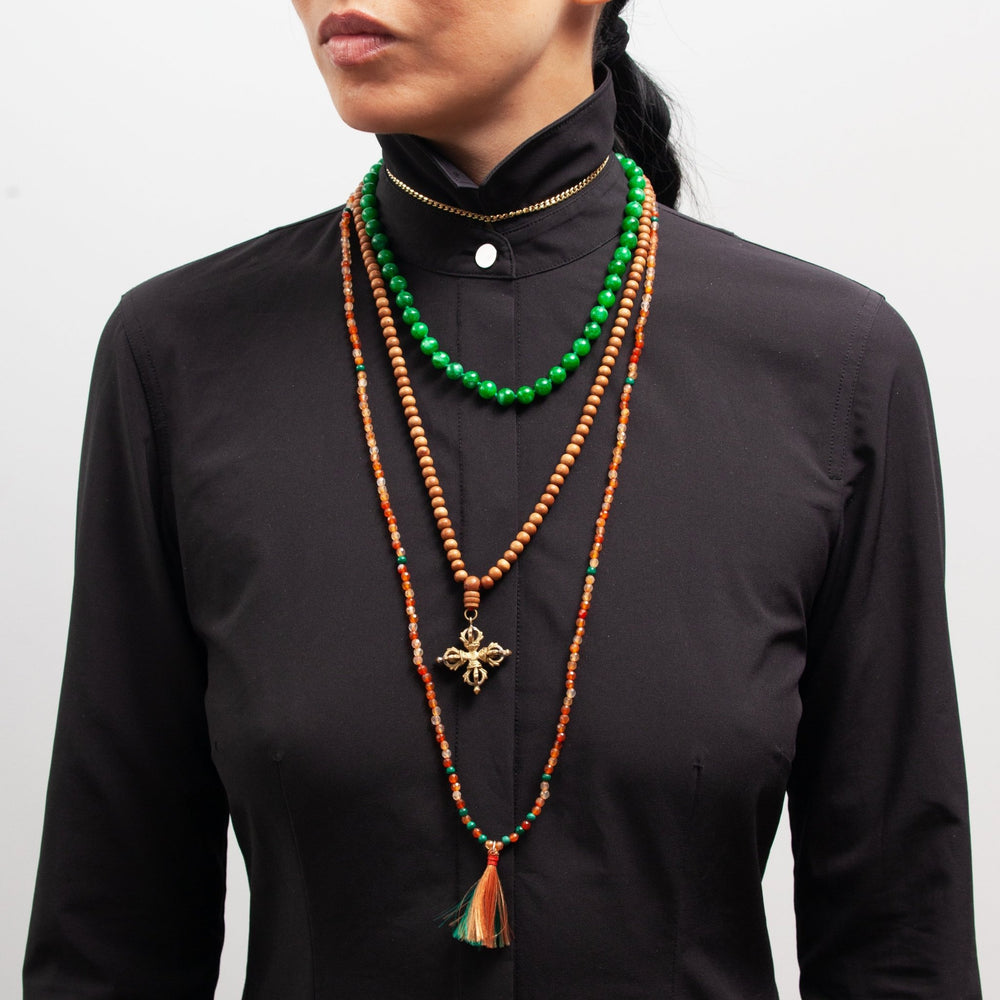
Malas with 108 beads are considerably longer than ordinary necklaces. Their length depends on the bead size. They are worn long or wrapped several times around the wrist.
| Length | Women | Men |
|---|---|---|
| 35–40 cm | close to the neck to base of neck | usually too tight |
| 42–45 cm | on the collarbone | at the base of the neck |
| 50 cm | just below the collarbone | at the collarbone |
| 55–60 cm | on the breastbone | below the collarbone to mid-chest, common with a pendant |
| 70–90 cm | at chest level, long | mid-chest and lower |
Guide values. Because of their larger neck circumference, the same necklace usually sits higher on men than on women. Exactly where it falls depends on neck size and build. The most commonly worn lengths are 42–45 cm for women and 50 cm for men.
Rings
With a ring that fits

- Place a ring that fits well on a ruler.
- Measure the inner diameter, from inner edge to inner edge.
- Look up the diameter in the table.
On the finger

- Wrap a thin strip of paper or thread around the finger where the ring will sit, not too tight.
- Mark the point where the ends meet.
- Measure the length up to the mark in millimetres. It equals the inner circumference and thus the ring size (EU/CH).
Conversion table
Swiss and European ring sizes equal the inner circumference in millimetres. The most common sizes are highlighted. US sizes are rounded guide values.
| EU/CH = inner circumference mm | Diameter inner, mm | US (approx.) | Typical for |
|---|---|---|---|
| 48 | 15.3 | 4.5 | Women very small, children |
| 49 | 15.6 | 5 | |
| 50 | 15.9 | 5.5 | |
| 51 | 16.2 | 5.5 | Women small |
| 52 | 16.6 | 6 | |
| 53 | 16.9 | 6.5 | |
| 54 | 17.2 | 7 | Women, most common sizes |
| 55 | 17.5 | 7 | |
| 56 | 17.8 | 7.5 | |
| 57 | 18.1 | 8 | Women large; men small |
| 58 | 18.5 | 8.5 | |
| 59 | 18.8 | 9 | |
| 60 | 19.1 | 9 | Women very large; men, most common sizes |
| 61 | 19.4 | 9.5 | |
| 62 | 19.7 | 10 | |
| 63 | 20.1 | 10.5 | Men, most common sizes |
| 64 | 20.4 | 11 | Men large |
| 65 | 20.7 | 11 | |
| 66 | 21.0 | 11.5 | |
| 67 | 21.3 | 12 | Men very large |
| 68 | 21.6 | 12.5 | |
| 69 | 22.0 | 12.5 | |
| 70 | 22.3 | 13 |
Tips
Measure in the evening if possible, as fingers swell slightly during the day.
If the measurement falls between two sizes, choose the larger one.
The ring must also fit over the knuckle.
If in doubt, we are happy to measure your size in our shop at Münstergasse 10 in Zurich.