
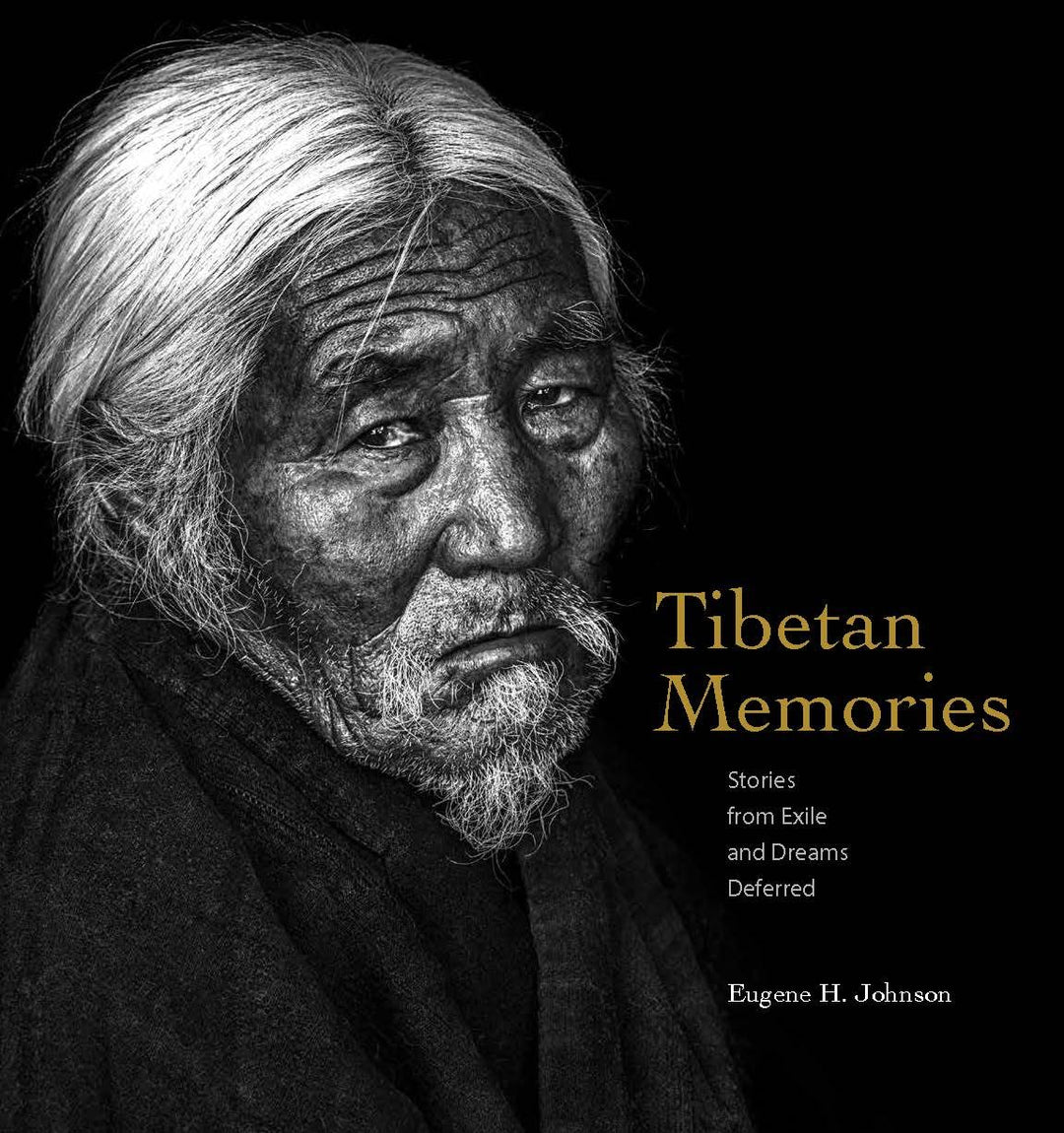
Johnson, Eugene H: Tibetan Memories
Stories from Exile and Dreams Deferred
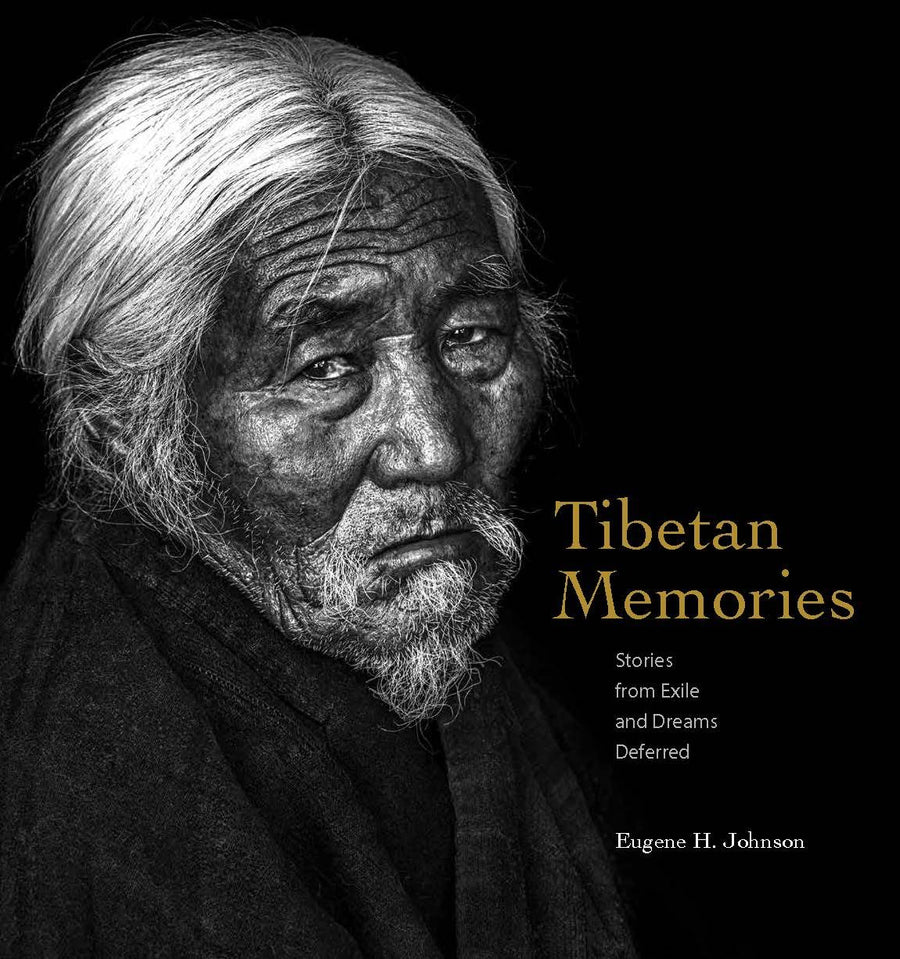
In a world full of exiles, more than 150,000 of which are Tibetan, this book is not only of historical significance, it puts a human face on the increasingly complex problem of people being forcibly displaced from their homelands...
Tibetan Memories is the first book to present the stories and compelling images of ordinary Tibetan women and men in exile. In their own words, we listen to the gravity of their situations, and each story is accompanied by uplifting black-and-white portraits of those featured and of Ladakh, where they found refuge after the Chinese communists took over their homeland in 1959.
In a world full of exiles and refugees, 150,000 of whom are Tibetan, this book is not only of historical significance, it is timely. It puts an unforgettable human face on the increasingly complex and growing problem of people being forcibly displaced from their homeland--as many as 110 million according to a recent U.N. study.
To meet the people and make these photographs, Dr. Johnson and his wife, Mirasol, traveled throughout Ladakh, visiting many villages and talking with dozens of people. Most of them had to leave everything behind when they fled: their family, friends, and animals, often their most precious possessions and with whom they had a unique and symbiotic relationship.
The situation of the Tibetan refugees in Ladakh and the rest of India, which has the highest concentration of Tibetan refugees, is particularly heartbreaking and challenging. They cannot become citizens, own land or property, or travel internationally or freely even throughout India. They also are excluded from government or other public jobs.
Yet, as Dr. Johnson reveals in his photographs and stories, all of these refugees are remarkably resilient, wise, and hopeful. They have made their tragedy--and their enduring devotion to their spiritual leader, the Dalai Lama, and to their Buddhist practice--sources of strength which continue to sustain them. With an enduring faith, they maintain their belief that Tibet will one day be free, believing that losing that hope would be the ultimate disaster.
In these often difficult and dark times throughout the world, when too many people are uncertain of their future and concerned about the future well-being of the planet, these remarkable individuals from Tibet show us the meaning of hope and of never giving up. They also show us that every human being deserves compassion, for, without it, the future of humanity stands in peril.
This guide helps you find the right size for bracelets, chain bracelets, cuffs, bangles, necklaces and rings. All you need is a tape measure or a strip of paper and a ruler.
Bracelets and chain bracelets

- Wrap a tape measure or string around the wrist where the bracelet will sit.
- It should sit snugly without cutting in.
- Read off the circumference or measure the string with a ruler.
Depending on the desired fit, the bracelet can be 1 to 3 cm longer than the wrist circumference: less for a close fit, more for a loose fit.
Elastic bracelets such as mala bracelets have no clasp. They should fit rather snugly, as they stretch slightly over time. When putting them on, stretch them only as far as necessary.
| Size | Wrist circumference |
|---|---|
| Children | |
| Newborns | 9–12 cm |
| 6 months to 3 years | 12–14 cm |
| 4 to 10 years | 14–15 cm |
| Teenagers | 15–16 cm |
| Women | |
| S | 15–16 cm |
| M | 16–17 cm |
| L | 17–18 cm |
| XL | 18–19 cm |
| Men | |
| S | 17–18 cm |
| M | 18–20 cm |
| L | 20–21 cm |
| XL | 21–22 cm |
Bangles and cuffs

Bangles (closed)
A closed bangle has to slide over the hand. What counts is therefore the widest part of the hand, not the wrist.
- Tuck the thumb into the palm, as when putting on a bangle.
- Measure the circumference across the knuckles at the widest point.
- The inner circumference of the bangle should be slightly larger than this measurement.
Cuffs (open)
An open cuff is slipped onto the wrist from the side. What counts is the wrist circumference, measured as for bracelets. Many cuffs can be gently reshaped. Bend them softly and not repeatedly, otherwise the metal may fatigue.
Necklaces
The length determines where the necklace falls. The easiest way to try it is with a piece of string:
- Place a string around the neck the way the necklace should fall.
- Mark the point where the ends meet.
- Measure the string. This is the right necklace length.
With a pendant, the lowest point moves down by the height of the pendant.
Malas with 108 beads are considerably longer than ordinary necklaces. Their length depends on the bead size. They are worn long or wrapped several times around the wrist.
| Length | Women | Men |
|---|---|---|
| 35–40 cm | close to the neck to base of neck | usually too tight |
| 42–45 cm | on the collarbone | at the base of the neck |
| 50 cm | just below the collarbone | at the collarbone |
| 55–60 cm | on the breastbone | below the collarbone to mid-chest, common with a pendant |
| 70–90 cm | at chest level, long | mid-chest and lower |
Guide values. Because of their larger neck circumference, the same necklace usually sits higher on men than on women. Exactly where it falls depends on neck size and build. The most commonly worn lengths are 42–45 cm for women and 50 cm for men.
Rings
With a ring that fits

- Place a ring that fits well on a ruler.
- Measure the inner diameter, from inner edge to inner edge.
- Look up the diameter in the table.
On the finger

- Wrap a thin strip of paper or thread around the finger where the ring will sit, not too tight.
- Mark the point where the ends meet.
- Measure the length up to the mark in millimetres. It equals the inner circumference and thus the ring size (EU/CH).
Conversion table
Swiss and European ring sizes equal the inner circumference in millimetres. The most common sizes are highlighted. US sizes are rounded guide values.
| EU/CH = inner circumference mm | Diameter inner, mm | US (approx.) | Typical for |
|---|---|---|---|
| 48 | 15.3 | 4.5 | Women very small, children |
| 49 | 15.6 | 5 | |
| 50 | 15.9 | 5.5 | |
| 51 | 16.2 | 5.5 | Women small |
| 52 | 16.6 | 6 | |
| 53 | 16.9 | 6.5 | |
| 54 | 17.2 | 7 | Women, most common sizes |
| 55 | 17.5 | 7 | |
| 56 | 17.8 | 7.5 | |
| 57 | 18.1 | 8 | Women large; men small |
| 58 | 18.5 | 8.5 | |
| 59 | 18.8 | 9 | |
| 60 | 19.1 | 9 | Women very large; men, most common sizes |
| 61 | 19.4 | 9.5 | |
| 62 | 19.7 | 10 | |
| 63 | 20.1 | 10.5 | Men, most common sizes |
| 64 | 20.4 | 11 | Men large |
| 65 | 20.7 | 11 | |
| 66 | 21.0 | 11.5 | |
| 67 | 21.3 | 12 | Men very large |
| 68 | 21.6 | 12.5 | |
| 69 | 22.0 | 12.5 | |
| 70 | 22.3 | 13 |
Tips
Measure in the evening if possible, as fingers swell slightly during the day.
If the measurement falls between two sizes, choose the larger one.
The ring must also fit over the knuckle.
If in doubt, we are happy to measure your size in our shop at Münstergasse 10 in Zurich.