

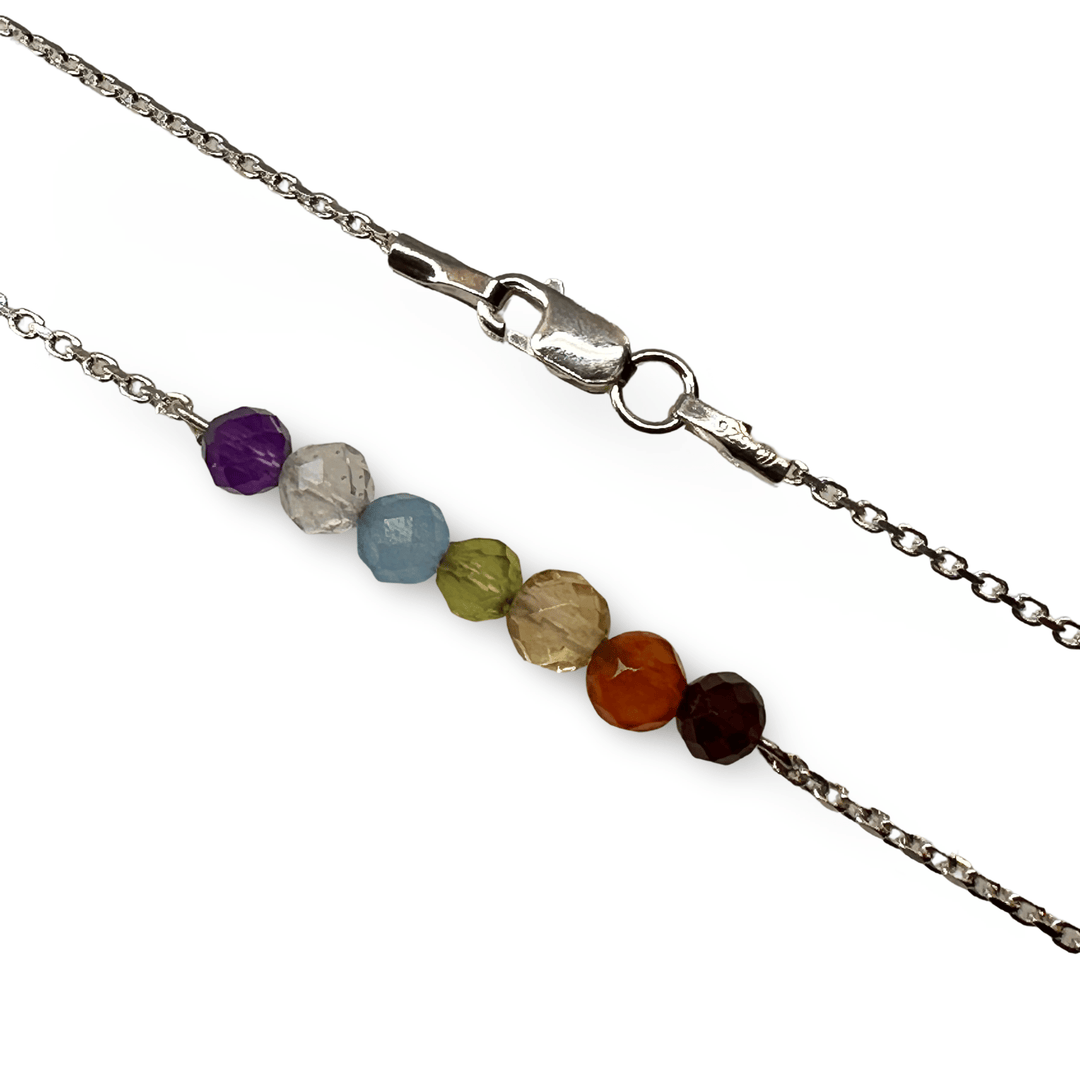
Silver necklace with faceted chakra stones
Fine necklace made of silver with a spring clasp, with seven faceted chakra stones, which we string at Atelier Tibet in Zurich.
Chakra stones are gemstones that are assigned to specific chakras (energy centers) in the body. Each stone supports a specific chakra through its color and energy. They are used to promote balance and well-being in meditation and healing practices. The Seven chakras are:
- Root Chakra - Garnet: Supports grounding, strength and stability.
- Sacral chakra - Carnelian: Promotes creativity, vitality and zest for life.
- Solar plexus chakra - citrine: Strengthens self-confidence and positive energy.
- Heart chakra - peridot: Promotes compassion, harmony and emotional healing.
- Throat chakra - aquamarine: Supports communication and self-expression.
- Brow chakra - rock crystal: Increases clarity and awareness, strengthens the connection to the higher self.
- Crown chakra - amethyst: Helps with spiritual growth, promotes inner peace and meditation.
Regular price
CHF 38.00
CHF 38.00
Regular price
Sale price
CHF 38.00
CHF 38.00
Save
/
Size chart
Bracelets, bangles, bangles, necklaces
| age | Wrist circumference |
|
Newborn |
9 - 12 cm |
|
6 months - 3 years |
12 - 14 cm |
|
4 - 10 years |
14 - 15 cm |
|
Teenager, ladies (XS) |
15 - 16 cm |
|
Ladies (M) |
16 - 17 cm |
|
Ladies (XL) |
18 - 19 cm |
|
Men (M) |
18 - 20 cm |
|
Men (XL) |
21 - 22 cm |
Brief instructions for measuring wrist size:
Loosely wrap a measuring tape or string around your wrist where you want the bracelet to sit. Make sure that it fits snugly but does not cut in. Read the circumference directly from the measuring tape or measure the length of the cord with a ruler.
Note:
The length of the bracelet may be 1 cm to 3 cm longer than the measured wrist circumference, depending on your taste.
The length of the bracelet may be 1 cm to 3 cm longer than the measured wrist circumference, depending on your taste.
Finger rings
Ring size conversion table
| EU / CH | US size | UK size | Inner diameter (mm) | Inner circumference (mm) |
|---|---|---|---|---|
| 48 | 4.5 | I | 15.3 | 48.0 |
| 49 | 5 | J | 15.6 | 49.0 |
| 50 | 5.5 | J½ | 15.9 | 50.0 |
| 51 | 6 | K | 16.2 | 51.0 |
| 52 | 6.5 | L | 16.6 | 52.0 |
| 53 | 7 | M | 16.9 | 53.0 |
| 54 | 7.5 | N | 17.2 | 54.0 |
| 55 | 8 | O | 17.5 | 55.0 |
| 56 | 8.5 | P | 17.8 | 56.0 |
| 57 | 9 | P½ | 18.2 | 57.0 |
| 58 | 9.5 | Q | 18.5 | 58.0 |
| 59 | 10 | R | 18.9 | 59.0 |
| 60 | 10.5 | S | 19.2 | 60.0 |
| 61 | 11 | S½ | 19.6 | 61.0 |
| 62 | 11.5 | T | 19.8 | 62.0 |
| 63 | 12 | U | 20.3 | 63.0 |
| 64 | 12.5 | V | 20.6 | 64.0 |
| 65 | 13 | W | 20.9 | 65.0 |
| 66 | 13.5 | X | 21.3 | 66.0 |
| 67 | 14 | Y | 21.6 | 67.0 |
| 68 | 14.5 | Z | 21.8 | 68.0 |
| 69 | 15 | Z+1 | 22.1 | 69.0 |
| 70 | 15.5 | Z+2 | 22.5 | 70.0 |
Size categories:
Women:
- Very small: 48-50 (children/very petite)
- Small: 51-53 (petite hands)
- Standard: 54-56 ← most common sizes
- Large: 57-59 (strong hands)
- Very large: 60-62
Men:
- Small: 57-59 (narrow hands)
- Standard: 60-63 ← most common sizes
- Large: 64-66 (strong hands)
- Very large: 67-70 (very strong hands)
Brief instructions for measuring ring size:
Method 1: Measure the inner diameter of a suitable ring
- Take a ring that fits well.
- Place it on a ruler and measure the inside diameter (from one inner edge to the other).
- Compare the diameter with the table to determine the ring size.
Method 2: Measure the circumference of your finger
- Take a thin strip of paper or thread.
- Wrap it around the part of the finger where you want the ring to sit (not too tight).
- Mark the point where the ends meet.
- Measure the length of the strip in millimeters. This is the inner circumference.
- Find the right size in the table.
Tips:
- Measure the finger size in the evening, as fingers swell slightly during the day.
- If you are between two sizes, choose the larger size.
- Make sure that the ring fits over the knuckle.
