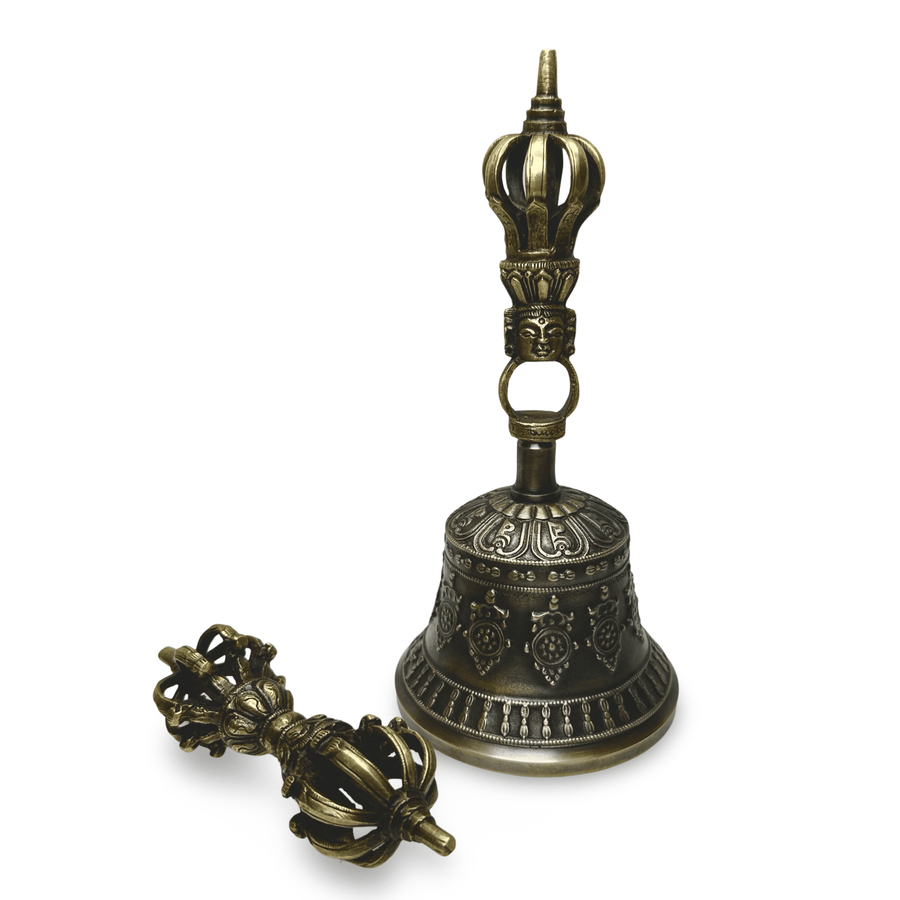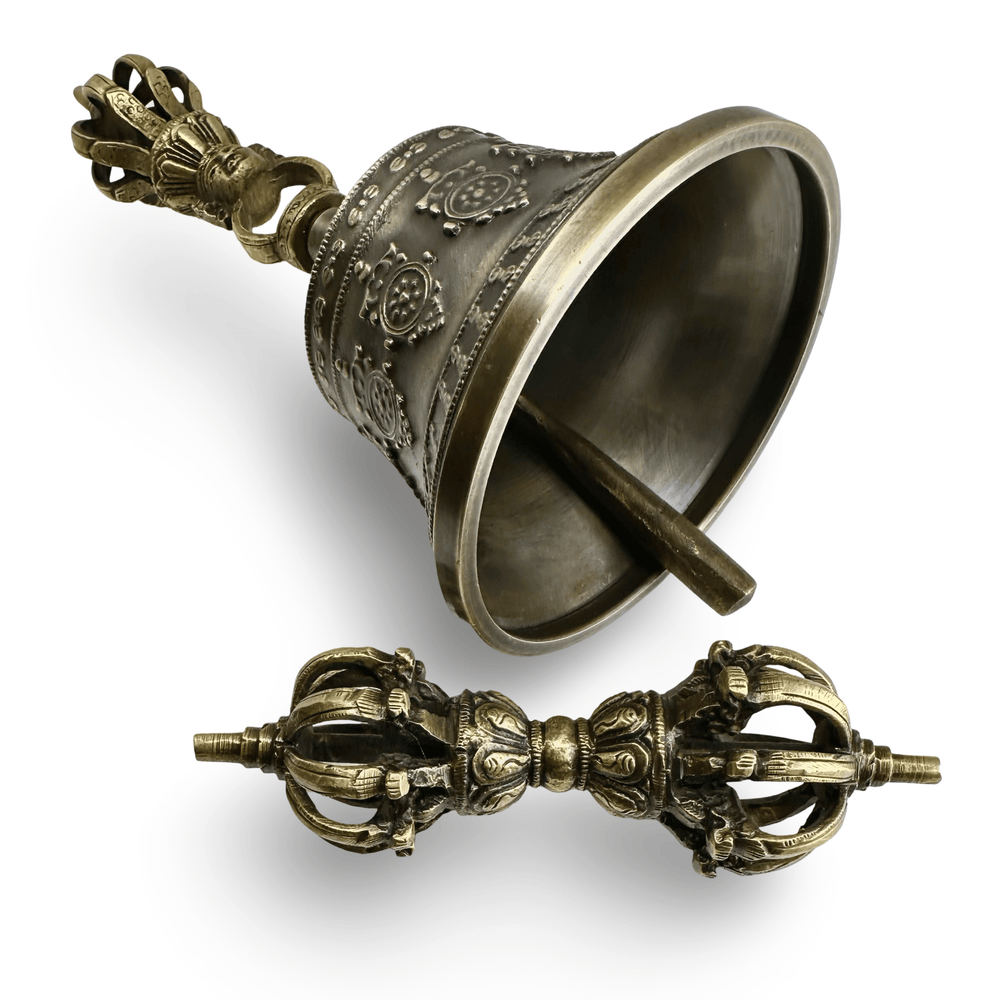



This bronze Vajra & Ghanta set is a classic ritual ensemble of Tibetan Buddhism (Vajrayana). It is traditionally used in meditations, mantra recitations and ceremonies. Together, vajra and ghanta stand for the unity of method and wisdom, a central principle of Vajrayana Buddhism.
The ghanta (ritual bell) is richly decorated with mantras, Buddhist symbols and figures. Its handle is designed as a vajra motif. The sound of the bell is clear and carrying and serves to focus the mind.
The vajra (dorje) has the typical double-sided shape with a central shaft and symbolic ends. It is solidly crafted and lies balanced in the hand.
Mass:
Dorje (vajra): Length approx. 12 cm
Bell (Ghanta): Height approx. 17 cm, diameter approx. 9.2 cm
Material: Bronze
In practice, the bell is usually held and struck in the left hand, while the vajra is held in the right hand. Both are used synchronously with mantras and ritual movements. The sound of the bell accompanies the practice, while the vajra marks gestures and inner alignment.
We offer matching brocade sleeves in various colors that can be closed with brass buttons. This version fits into the smaller brocade case.
| age | Wrist circumference |
|
Newborn |
9 - 12 cm |
|
6 months - 3 years |
12 - 14 cm |
|
4 - 10 years |
14 - 15 cm |
|
Teenager, ladies (XS) |
15 - 16 cm |
|
Ladies (M) |
16 - 17 cm |
|
Ladies (XL) |
18 - 19 cm |
|
Men (M) |
18 - 20 cm |
|
Men (XL) |
21 - 22 cm |
| EU / CH | US size | UK size | Inner diameter (mm) | Inner circumference (mm) |
|---|---|---|---|---|
| 48 | 4.5 | I | 15.3 | 48.0 |
| 49 | 5 | J | 15.6 | 49.0 |
| 50 | 5.5 | J½ | 15.9 | 50.0 |
| 51 | 6 | K | 16.2 | 51.0 |
| 52 | 6.5 | L | 16.6 | 52.0 |
| 53 | 7 | M | 16.9 | 53.0 |
| 54 | 7.5 | N | 17.2 | 54.0 |
| 55 | 8 | O | 17.5 | 55.0 |
| 56 | 8.5 | P | 17.8 | 56.0 |
| 57 | 9 | P½ | 18.2 | 57.0 |
| 58 | 9.5 | Q | 18.5 | 58.0 |
| 59 | 10 | R | 18.9 | 59.0 |
| 60 | 10.5 | S | 19.2 | 60.0 |
| 61 | 11 | S½ | 19.6 | 61.0 |
| 62 | 11.5 | T | 19.8 | 62.0 |
| 63 | 12 | U | 20.3 | 63.0 |
| 64 | 12.5 | V | 20.6 | 64.0 |
| 65 | 13 | W | 20.9 | 65.0 |
| 66 | 13.5 | X | 21.3 | 66.0 |
| 67 | 14 | Y | 21.6 | 67.0 |
| 68 | 14.5 | Z | 21.8 | 68.0 |
| 69 | 15 | Z+1 | 22.1 | 69.0 |
| 70 | 15.5 | Z+2 | 22.5 | 70.0 |
Women:
Men:
Subscribe to our newsletter for product news, event tips and cultural information, and receive a 10% discount on your first order. You can unsubscribe at any time with just one click.